Why last year's cutoff won't be this year's: what three years of Telangana MBBS data shows
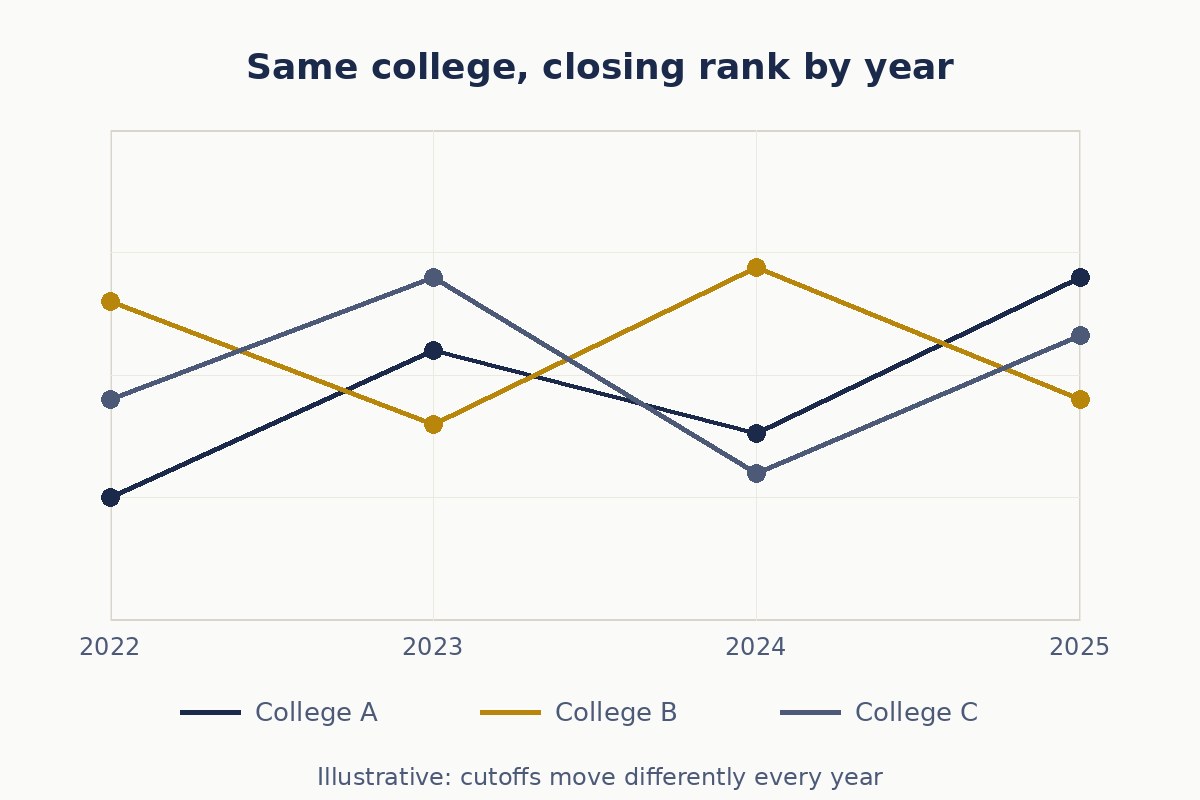
Almost every cutoff list you will find online treats last year's closing rank as a fixed target. We compared real KNRUHS data across several years to see whether that holds up. Mostly, it does not, but there is a useful pattern underneath.
The applicant pool keeps changing size
The number of candidates on the KNRUHS merit list was 13,651 in 2022-23, jumped to 22,222 in 2023-24, and came back down to 16,620 in 2025-26. That is a 63% increase in a single year, followed by a drop. Ranks are positions within a pool, so when the pool grows, the same college tends to close at a larger rank number even if nothing about the college has changed.
What we measured
We matched each year's allotment list to its merit list, worked out the closing rank for each college, category and round, and compared the same cell across years. Between 2022-23 and 2023-24 first-round lists, the median closing category rank shifted by about 34%, and only around a third of college-and-category cells stayed within 25% of the previous year.
The order of colleges is stable
Here is the reassuring part. If you rank colleges from hardest to easiest to get into, that ordering is very consistent from year to year. The correlation between years was between roughly 0.89 and 0.99 on a scale where 1.0 means identical order. In plain terms: Osmania stays harder than a newer district college, year after year. What moves is the absolute number.
Adjusting for competition helps
We tested several ways of putting different years on the same scale. The one that worked best was dividing by the number of candidates per seat, in other words how crowded the pool was relative to the seats available. After that adjustment, the share of cells agreeing within 25% year to year rose from about 36% to about 51%. It is better, but still far from exact. Cutoffs are noisy, especially in categories with only one to three seats.
What this means for you
- Treat any cutoff as a rough zone, not a line. Being a few percent on the wrong side of last year's number is not a rejection.
- Trust the ranking of colleges more than the exact figures.
- Check how many candidates are on this year's merit list compared with last year's. A bigger list generally pushes closing ranks up; a smaller one pulls them down.
- Be more cautious with tiny categories. When a college has one or two seats in your category, a single admission can swing the cutoff.
One limitation: this comparison uses the years for which we have both a merit list and allotment lists. The 2024-25 cycle is not included yet, and we will update this article when it is. You can try the adjusted cutoffs yourself in the rank predictor.
Try the rank predictorEnter your state merit rank and category to see which Telangana colleges are in range.